ML & GenAI
Models you can trace, and AI that reads only what it may.
Experiments, a model registry and serving, with promotion gated on a model card and an approval and every version traced to the snapshot it trained on. For generative AI: corpora, embeddings and a per-tenant vector index, with retrieval filtered by the person asking.
The advantages
The outcomes this product is built around.
Every model traces to its data
A version records the run that made it and the exact table snapshot that run read, so “what was this trained on?” has an answer.
Nothing reaches production undocumented
Promotion to production is refused until the version has a model card and a reviewer’s approval.
Retrieval sees what the asker sees
Retrieval is filtered by the requesting user at query time, so an assistant never surfaces a document its user could not open.
Inference where you decide
Route to self-hosted or external models by policy, or turn on sovereign mode and forbid external inference entirely.
- separate sign-offs, card then approval, before production
- 2
- rollout strategies: canary, shadow, A/B and blue-green
- 4
- vector index per tenant, never shared
- 1
See it in the console
Real screens from the product, not mock-ups.
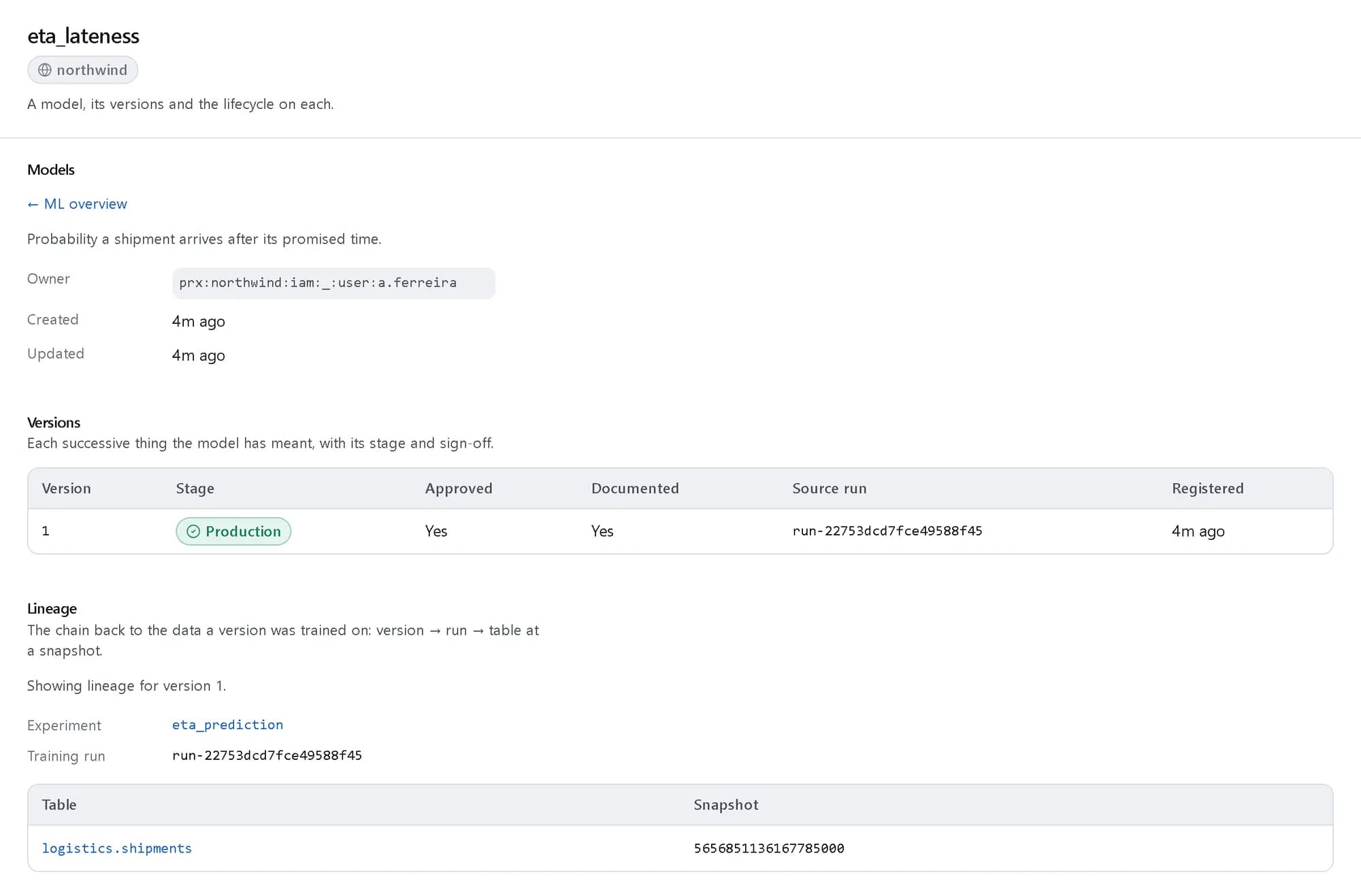
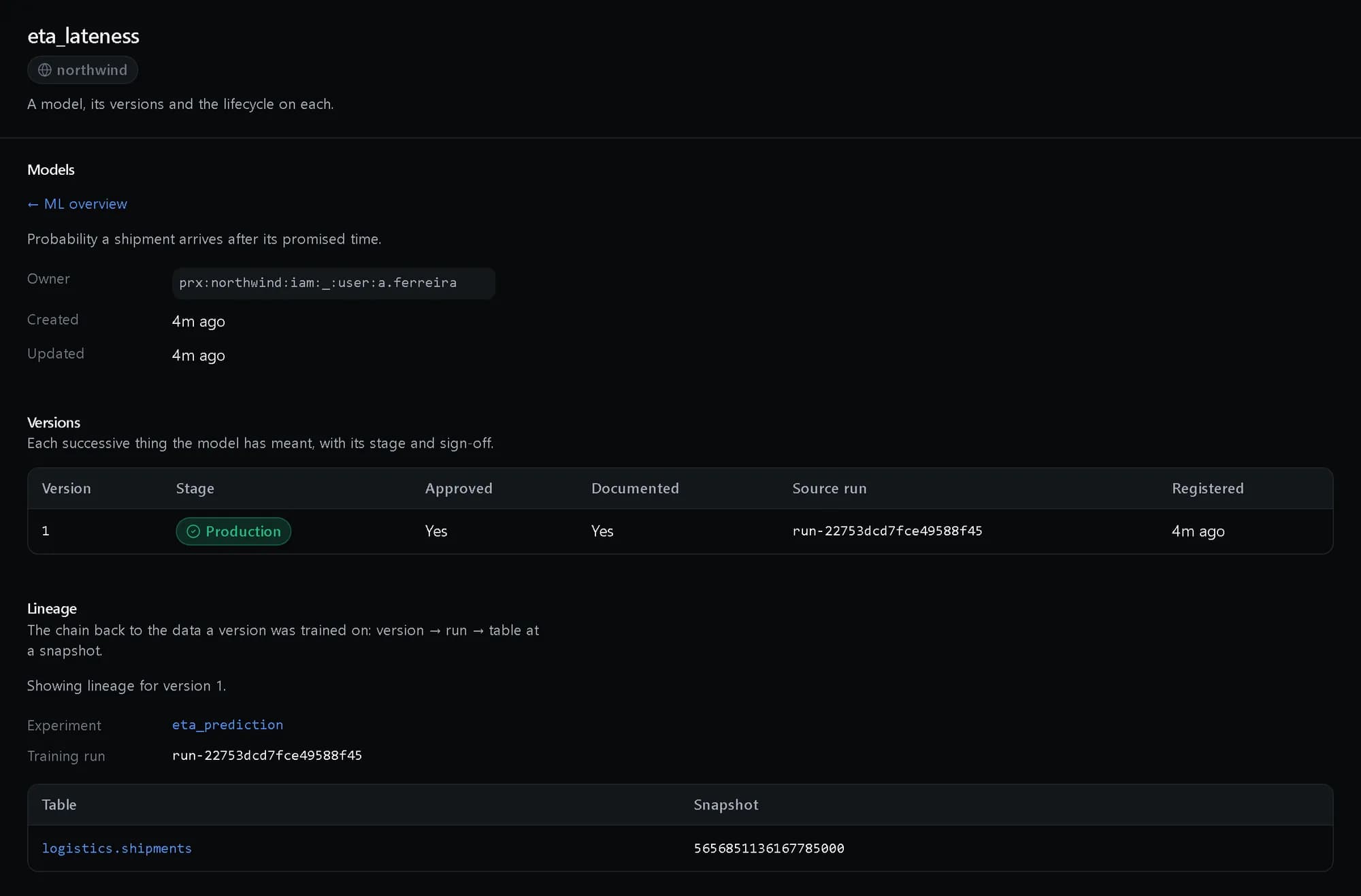
A model, documented and traced
The production version with its approval and card, and its lineage to the snapshot it trained on.
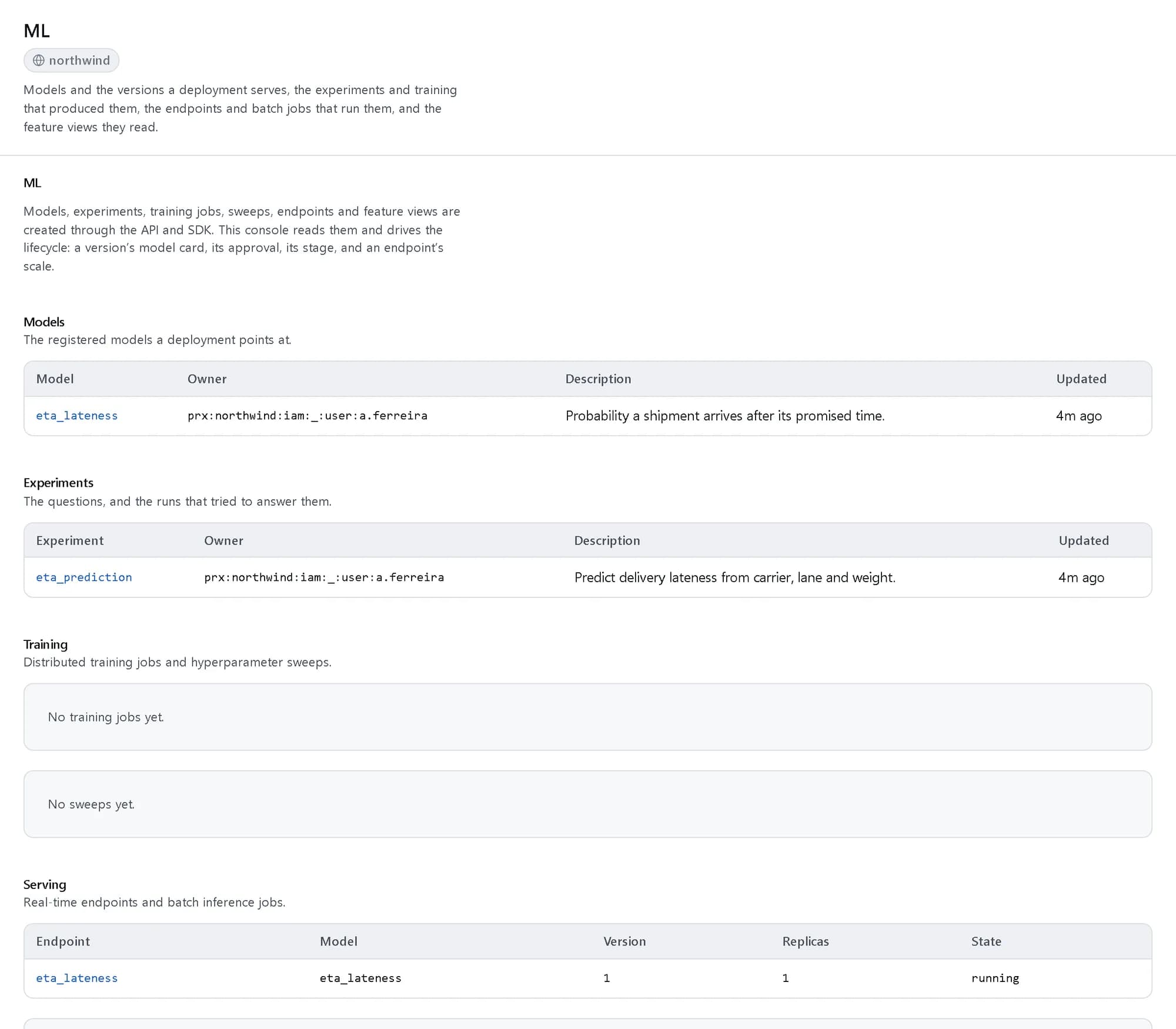
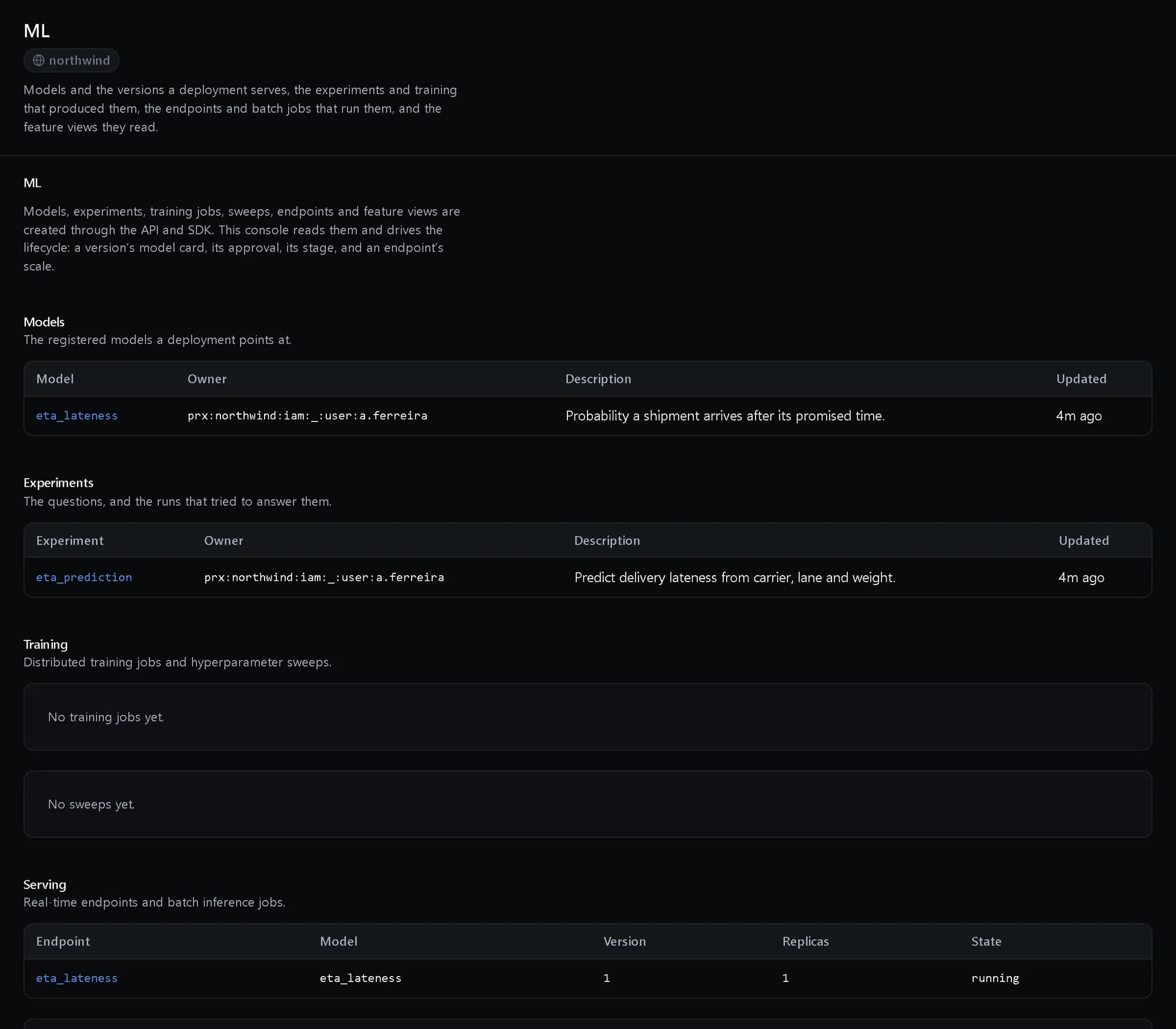
Models, runs and endpoints
The registered models, the experiments behind them and the endpoints serving them.
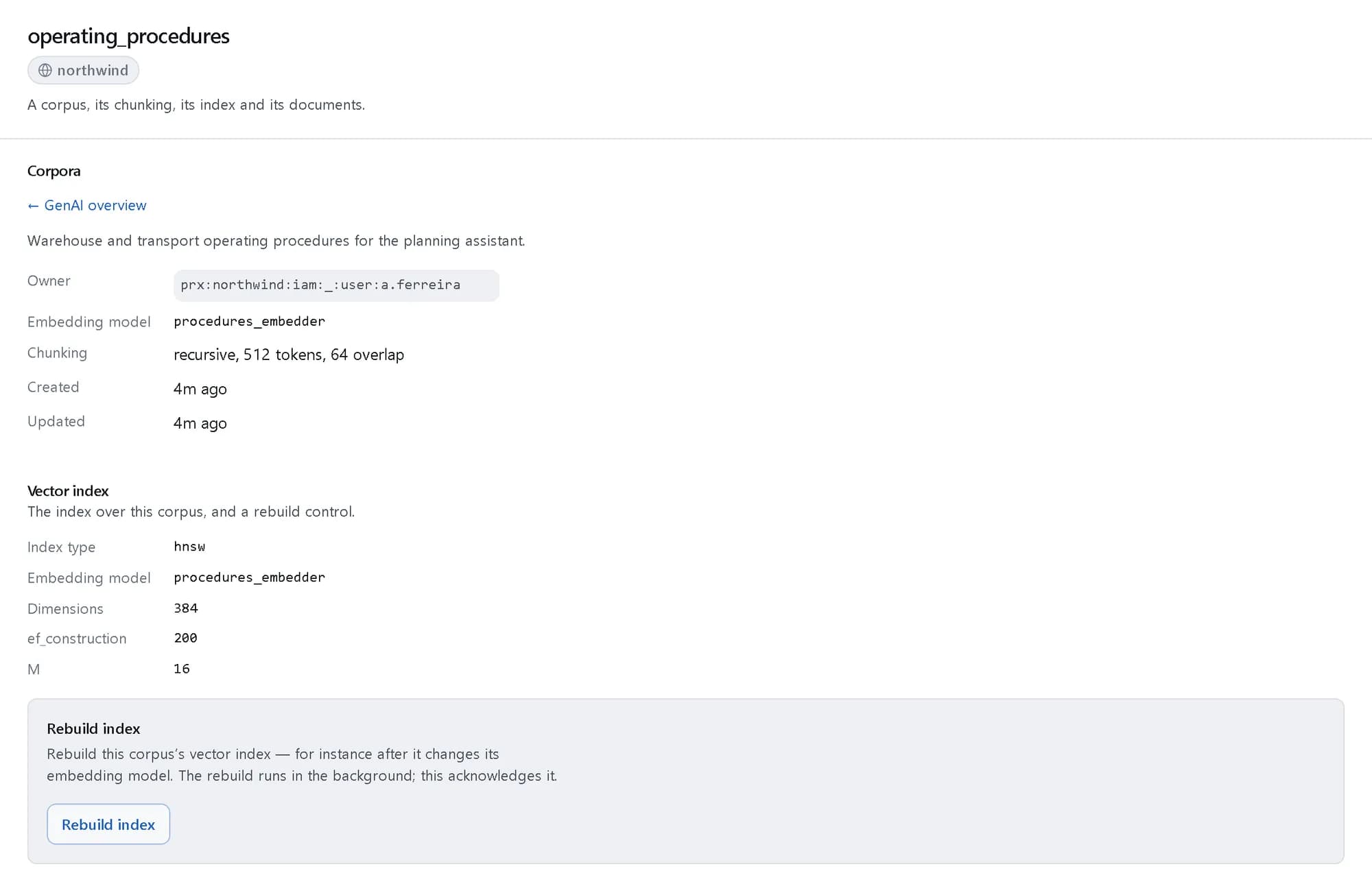
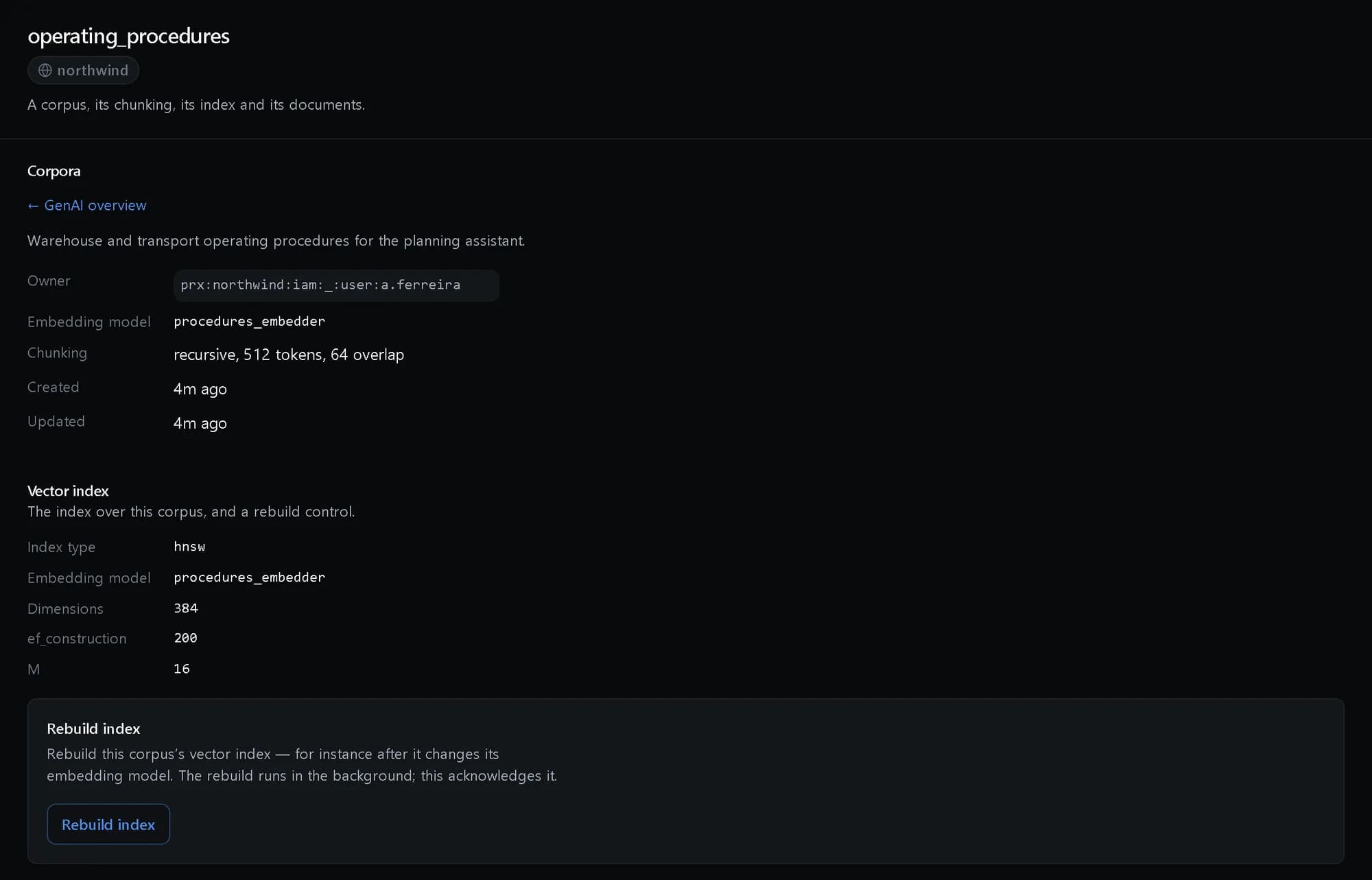
A corpus and its index
The chunking and embedding model of a document corpus, and the vector index built over it.
How it fits together
What happens between your request and a running resource.
A run reads tables at pinned snapshots and records its results. The best run becomes a registered version, which needs a model card and an approval before it may be promoted, and only then goes behind a serving endpoint.
- Table snapshot: pinned (Data)
- Training run: params · metrics (Data)
- Model version: card + approval (The registry)
- Endpoint: autoscaling (Serving)
- Drift checks: data · predictions (Serving)
- Table snapshot to Training run: read by
- Training run to Model version: registered
- Model version to Endpoint: production
- Endpoint to Drift checks
Who it is for
The teams and situations this product was built for.
Data science teams
Experiments, versions and deployments without a separate platform to run.
Tracked runs, a registry with stages and approvals, and endpoints with canary and blue-green rollouts.
Risk and compliance
Proof of what a production model is, what it was trained on and who signed it off.
A model card and approval for every production version, and lineage to the training snapshot.
Teams building assistants
Answers grounded in company documents without leaking them to the wrong person.
Per-tenant vector indexes, permission-aware retrieval, guardrails and token budgets.
What it does
The core capabilities, live in the product today.
Experiments, training and evaluation
Track parameters, metrics and artifacts; train on Spark and Ray with GPUs; search hyperparameters and evaluate by slice.
Every run records what it tried and how it scored, and pins the table snapshots it read. Training scales out on Spark or Ray, sweeps search the parameter space, and evaluation breaks results down by slice and checks fairness.
A registry with a gate
Versions, stages and approvals, with a model card required before production and lineage back to the training snapshot.
Documenting a version is the author’s job and approving it the reviewer’s, held apart on purpose. Production is refused until both are done, and the version always traces to the run and snapshot behind it.
Serving and monitoring
Autoscaling real-time endpoints, batch inference, canary, shadow, A/B and blue-green rollouts, and drift monitoring.
An endpoint scales with traffic and a new version can be rolled out to a slice first, shadowed, or swapped blue-green. Drift checks watch the data, the concept and the predictions once it is live.
Retrieval and generation, governed
Corpora with configurable chunking, embeddings, a per-tenant HNSW index, hybrid search and reranking, composed into RAG pipelines with guardrails and budgets.
Documents are chunked and embedded into an index that belongs to your tenant alone. Retrieval fuses dense and keyword search, reranks, and filters by the asker’s permissions; pipelines add guardrails, output schemas and token budgets.
The ideas behind it
The words this page uses, explained once.
- Model card
- What a version is for, what it was trained on, where it falls down and who it could affect. Required before production.
- Lineage to a snapshot
- The chain version → run → table at a snapshot, so the training data is the exact rows the run read, not today’s table.
- Permission-aware retrieval
- Retrieval that filters candidate documents by the requesting user’s permissions at query time, before anything reaches a model.
In depth
The detail an evaluation asks for.
Features without leakage
A feature store keeps features offline in Iceberg and online for serving, with point-in-time correct retrieval so training never reads the future.
Guardrails and budgets
Pipelines redact personal data, defend against prompt injection, filter toxicity, validate output against a schema and stop at a token budget per tenant, user or agent.
Evaluation you can repeat
An evaluation harness scores groundedness, relevance, latency and cost, and prompts are versioned so a change can be A/B tested.
How it works
- Python SDK
Track the runs
Log each run’s parameters, metrics and the table snapshots it read.
- API
Register and document
Register the best run as a version and write its model card.
- Console
Approve and promote
A reviewer approves it; only then can it move to production.
- API
Serve it
Put it behind an autoscaling endpoint and roll later versions out gradually.
In code
The same task in the CLI and both SDKs. Every call shown exists in the API.
prx CLI
Document, approve and promote a model version, then serve it
prx lakehouse model card eta_lateness 1 --body '{"intended_use":"Rank open shipments by lateness risk.","training_data":"logistics.shipments at a pinned snapshot.","limitations":"Not validated for air or sea freight.","ethical_considerations":"Scores shipments, not people."}'prx lakehouse model approval eta_lateness 1 --body '{"note":"Reviewed against the held-out week."}'prx lakehouse model stage eta_lateness 1 --body '{"stage":"production"}'prx lakehouse serving create-endpoints --body '{"endpoint":"eta_lateness","model":"eta_lateness","version":1,"autoscale":{"min_replicas":1,"max_replicas":4,"target_concurrency":8}}'TypeScript SDK
Document, approve and promote a model version, then serve it
await client.lakehouse.model.card('eta_lateness', 1, { intended_use: 'Rank open shipments by lateness risk.', training_data: 'logistics.shipments at a pinned snapshot.', limitations: 'Not validated for air or sea freight.', ethical_considerations: 'Scores shipments, not people.' });await client.lakehouse.model.approval('eta_lateness', 1, { note: 'Reviewed against the held-out week.' });await client.lakehouse.model.stage('eta_lateness', 1, { stage: 'production' });await client.lakehouse.serving.createEndpoints({ endpoint: 'eta_lateness', model: 'eta_lateness', version: 1, autoscale: { min_replicas: 1, max_replicas: 4, target_concurrency: 8 } });Python SDK
Document, approve and promote a model version, then serve it
client.lakehouse.model.card("eta_lateness", 1, {"intended_use": "Rank open shipments by lateness risk.", "training_data": "logistics.shipments at a pinned snapshot.", "limitations": "Not validated for air or sea freight.", "ethical_considerations": "Scores shipments, not people."})client.lakehouse.model.approval("eta_lateness", 1, {"note": "Reviewed against the held-out week."})client.lakehouse.model.stage("eta_lateness", 1, {"stage": "production"})client.lakehouse.serving.create_endpoints({"endpoint": "eta_lateness", "model": "eta_lateness", "version": 1, "autoscale": {"min_replicas": 1, "max_replicas": 4, "target_concurrency": 8}})The difference
The way this job usually goes, and the way it goes here.
The usual way
With ProjectX
Nobody can say which data the production model was trained on.
Every version traces to its run and the exact table snapshot it read.
A model ships because someone had deploy rights.
Production is refused until the version is documented and approved.
An assistant that quotes documents its user was never allowed to open.
Retrieval filtered by the person asking, at query time.
Works with your tools
Every surface below drives the same product — script it, click it, or hand it to your existing tooling.
- Python SDK
- API
- Console
- Spark
- Ray
Questions, answered
Can we prove what a model was trained on?
Yes. A version records the run that produced it, and the run pins the snapshot of every table it read, so the chain from production back to the data is on the record.
What stops an unreviewed model reaching production?
Promotion to production is refused until the version has a model card and an approval from a reviewer.
Which language models can we use?
The gateway routes to self-hosted models or to external providers by policy, with provider keys kept in the vault. Sovereign mode forbids external inference entirely.
Can an assistant leak documents?
Retrieval is filtered by the requesting user at query time, and guardrails redact personal data and defend against prompt injection.
How is it priced?
Training and serving compute is billed per second by cluster size, and model tokens by the token, at published rates in Platform Credits. The rates are on the pricing page.
Products it works with
Same platform, same console, same invoice.
Start with ProjectX today.
Create a company in minutes and add this product to your invoice at the published rate.